Saturday, September 30, 2006

Barcamp, Day 1


Our party of three is the youngest at Barcamp by far, being the only undergrads in the conference. Ben, Becky, and I are sharing a small "team room" in Microsoft's headquarters for our sleeping bags tonight, and I labeled the door "Barcamp Junior Members." It's 9:30pm, I'm stuffed with Indian food, hapily tired from a day of talking to random strangers, and really need to go to sleep. Before I do, a recap of some highlights from the day.

Presentation: Creative Habits for Entrepreneurs
My three favorite tips from this session were
  1. Eliminate distractions; get up early. Basically, give yourself down time. I'm notoriously poor at this, especially the "waking up" part. Still trying to figure out how to make this happen, but this is more confirmation that I really should be getting up more than 10 minutes before class starts.
  2. Create an archive. An institutional memory is something I've been bad at ("oh, none of my stuff really counts yet, it's not good yet.") The perfect is the enemy of the good.
  3. Go halfway and then look back. It's a balance between action and reflection.
  4. You don't learn from victory. Painfully true. When you fail, it's important to know whether the failure was because of skill (or lack thereof), concept, judgment, nerve, repetition, or something else.
  5. Don't burn out. Not actually part of the presentation, but a question asked afterwards. General consensus was that scheduling breaks/gym-time/dinner with friends every day (or almost every day, giving you 1-2 days of intensive work) was a good thing.
Discussion - How to spread the meme
This was the one that Becky, Ben, and myself hosted. It was small and we didn't really know how to get the dynamics of the group discussion going, but I still learned a lot - we went around the circle talking about how we got interested in technology and how we would have introduced our kid-selves to it if we'd known what we know now.

The most common point made was that kids needed something to care about; make them do projects that they want to make, not abstract exercises. Have them shadow experienced people, see real problems, not just textbooks. Another oft-heard refrain was that the right tools were vital (BASIC, Logo, Lego NXT, something flexible, powerful, extensible, moddable, and simple-yet-impressive that works perfectly straight out of the box). Curiously enough, this was the first time I'd heard the argument that modern toys might be making kids more creative; we've got more powerful toys, so we can do more powerful things. I'm still in the "the less you give them, the more they'll do with it" camp, but it was refreshing to hear that different perspective.

Half-baked idea: Earth 2.0
A geek conference isn't a geek conference without the obligatory "make up a rocket pitch in 10 minutes" activity. Forced to choose our name from a list of words, my 5-person team pitched Earth 2.0, a branding service that offered oil companies the image of positive contribution to the environment. We'd provide free recycling for consumers, with recyclables redeemable for gas credits (each consumer would have to choose one oil company to get credits from, building brand loyalty). The oil companies would pay the gas credits, the recycling fees, and our overhead for marketing them as friends to the community and environment. Everyone wins.


We even had a full-fledged website prototype (man, but the folks at Barcamp move fast) and a catchy tagline: "Recycle. Refuel, Renew." That's me in the white shirt standing second from right during our pitch. Ultimately, a group that proposed sending celebrities into space won the coveted prize of five glorious laptop bags (which I might just buy one of, if I ever decide to spend money on a laptop bag).

Presentation - Time Management for System Administrators

Tom Limoncelli, author of the book with the same title as the presentation, gave a talk on time management for geeks. It was quite good, and he was awfully helpful answering questions afterwards - I've got to get a copy of the book and talk to him again tomorrow when I'm not completely addled from lack of sleep. As a completely unorganized student geek, I've searched long and hard for a student-specific version of a book like this. The conclusion is that no good student-specific ones yet exist. A good starter would be a white paper on the topic. I'm putting it on my list of articles to write (right after I finish my two tirades on the first-year and electrical engineering curriculums at Olin respectively, and another on lecture-free learning); if anyone's interested in contributing let me know.

Here are the things Tom suggested, and what I'm going to do about them.

  1. Mutual interruption shield - get a coworker to switch off with; you handle their calls in the morning so they can work uninterrupted, and vice versa in the afternoon. I wonder if I can do this with a teammate or suitemate. It's somewhat less relevant since I'm a student and no longer on-call. But the message is clear - I need to schedule some non-interruptable time to work during.
  2. Turn chaos into routine - getting into the right groove/habit is incredibly efficient and frees up mental and physical resources for other things. Especially good for repeating, forgettable, and tiny maintenance tasks; also useful for social life ("Thursdays are dancing nights with the gang"). Just because my schedule's quasi-regular doesn't mean it can't still be exciting.
  3. Record all requests - also known as a ticketing system.
  4. Use a tickler folder as a to-do list - have one to-do list for every day of the week. I might not actually do this one, but his points of the two extremes (One Massive List Of Doom that never gets completed vs Millions Of Tiny Lists that are forever getting lost and confused) being terrible things to do are quite well taken.
  5. Document procedures you hate - huh. I never thought of my love of documentation as being a technique for coping with a hatred of redundancy before. If you document a task, that means someone else can do it.
Other events
I'm leaving out tons of stuff here - the talk on "Osama Bin Laden's Strategies as applied to entrepreneurship" (which was really about the atmosphere and strategies of startups in America today) included such gems as the concept of religion being the first form of media (it's where you went to get all your news), debates on how VCs evaluate proposals (a shiny presentation of a bad concept can win over a poor presentation of a good one), the similarities between filmmaking and startups, and the rise of rapid prototyping devices and consequently user involvement and customization in rapid-fire creation as a startup strategy instead of long and careful planning.
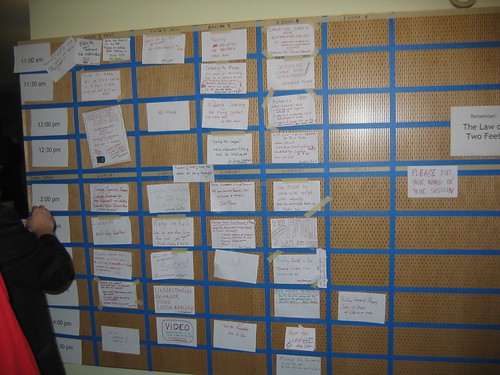
Then the discussions over dinner on open-source licensing, volunteering for engineers, and CMS design for nonprofits. And the room filled with gaming consoles and people fragging each other while waiting for Indian food. And now I'm sitting around the sofa listening to people talk and seeing pictures that folks have already posted from today on flickr. The schedule from today is still up on the wall (it's all ad-hoc; you post a piece of paper with what you want to talk about when you want to hold a session), so I have no idea what's happening tomorrow.

This means it is time for me to go to bed and make up for getting a half-hour of sleep last night so I can safely drive us home tomorrow evening.

Howdy from Barcamp

Went to bed 3am. Woke up 3:30am. Drove to NYC (with much thanks to Becky, who shook me awake, Ben, who drove from 5-7am as I dozed in the back, and Kevin, who lent us his GPS and prevented us getting horribly lost).

It is now 10AM and I'm sitting on a stylish lime-green sofa in Microsoft's headquarters in NYC next to Becky and Ben. We're at Barcamp, an unconference and the reason behind our insomnia driving spree. It's a quasi-random gathering of techies from the area hanging out and teaching each other things - the rule is that if you attend, you've got to present. So the three of us are running a discussion on "Spreading the meme: how people get into hacking and how we can get more." We're n00bs, after all, so we know how to talk about others like us.

More updates to come, I'm sure.

Sunday, September 24, 2006

Running noses and PDAs

There seems to be something going around school, because half the folks I know have been sick sometime in the last 3 weeks. This week it's my turn; I've somehow come to need 8 hours of sleep a night, have a continually running nose, and am awfully tired. Productivity has been less than stellar for the past 5 days. From prior experience, I usually feel worst about 2-3 days before I'm completely over this kind of thing, so I fully expect to be spry and running about by Wednesday. (I've also gotten considerably better at taking care of myself.)

Consequently, my room is in shambles again. The messiness function of my room looks a lot like a sawtooth wave. It's about to plunge back down again; I'm going on a cleaning fury right after this shower (sinuses... need... hot... steam).

On a completely different note, I've been toying with the idea of buying a PDA or Pocket PC (or smartphone, or something small, electronic, and personal-organizey) for a couple years; does anyone have any recommendations? I can't decide whether I want to go ultra cheap & low-tech (Hipster PDA) or insane (Dell Axim or Treo smartphone) or somewhere in between (Palm). I tend to be a pretty cheap person, but I'll spring for good tools that make my productivity dramatically rise.

Saturday, September 16, 2006

Audio processing and accessibilty design for the deaf

Random moment of geekiness: DJ walked into my suite talking about the Mel scale, which is the metric that describes distances (in Hz) of frequencies that people percieve as being linearly separated. You know how playing a scale on the piano sounds like a linear progression of notes when it's actually a logarithmic sequence of frequencies? That.

Several minutes later we were comparing notes on our perceptions of the colors of noise (play the .ogg files!) Pink noise (sound file) was particularly entertaining. It decreases in intensity as the frequency rises, but since humans hear high frequencies "louder" than they hear low ones, we hear it as an even hum, whereas white noise (sound file), which weights all frequencies evenly sounds much more biased towards the high end.

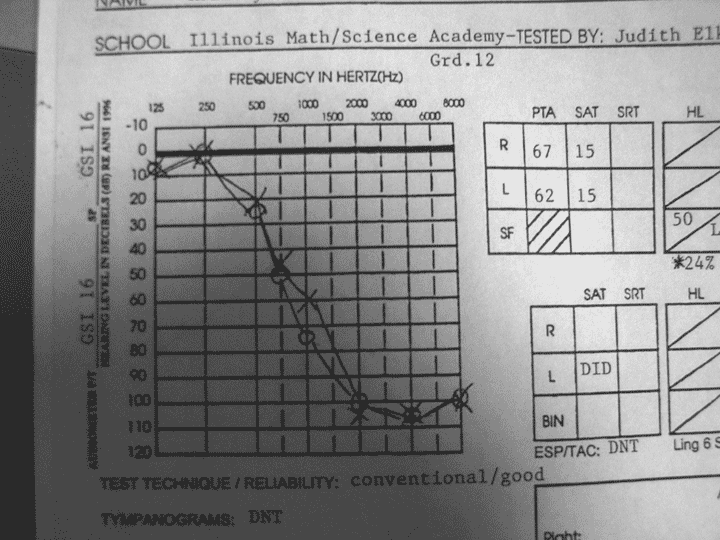
Ironically, my hearing profile acts sort of like an averaging filter; I can't hear high sounds nearly as well as I hear low ones. This means I actually percieve the volumes of sounds (the ones I can hear) closer to their "relative true volumes." That's kind of cool. And it's beginning to become academically relevant since DJ and I have been looking into speech recognition engines and algorithms for SCOPE and research, respectively. How can you process audio to have the smallest files possible while still retaining the ability for humans or computers to understand the speech contained within them? I think the solutions might be able to tell me something about how I'm able to hear people talk (I'm apparently not supposed to be able to understand speech as well as I do.)

On a semirelated note, I was shocked to find out this week that product design for accessibility for the deaf is pretty much nonexistent. I'm not talking about hearing aids and TDDs; those are product designs for the deaf. I mean making things that are used by everyone more accessible to deaf people - the equivalents of wheelchair ramps for buildings. I was fortunate enough to be an early and avid reader, so my difficulty in navigating the world is minimal; if it's captioned or has words on it, I'm fine.

Turns out this isn't the case for most. Half of deaf and hard-of-hearing 17-18 year olds read at or below a fourth grade level. (The grammar and vocabulary set of sign language is very different from that of written/spoken colloquial American english, hence the problem.) Picture a deaf teenager who wants to go to college. They can't hear lectures, can't hear their classmates discussing the material in the hallways, and can't read their textbooks. How are they supposed to access and understand higher-level academic information?

There is a misconception that "if it's captioned, it's accessible to deaf people." I am not sure how widespread - or how true - that statement really is, but I want to find out. One of the user interface design mailing lists I subscribe to mentions Sesame Street as a particularly egregious example. Sesame Street teaches little kids to read. And to expect a deaf toddler to read closed-captions in order to understand a television show that's trying to teach her how to read... well, you see a slight problem here.

I am really, really lucky. I was born hearing, so I learned that there was speech and that people communicated with it, and that this speech corresponded to those funny marks on paper. So when I lost my hearing, I was somehow able to make the mental jump to communicating almost entirely through those funny marks on paper as a way to get the equivalent information that the other kids got through speech. I learned to read fast at a very young age, and have now made it through 15 years of school on the strength of my ability to blaze through written texts. If it weren't for my reading abilities, I can almost guarantee you that I would have been labeled as a kid with academic difficulties, not a "gifted" one. If you've ever been in a class with me where I didn't have a good textbook, you know it's true. In fact, those classes correspond very, very closely to the almost-failing grades in my transcripts (and trust me, I've got some).

There's a weird sense of responsibility that since I'm an engineer and interested in product design, that I ought to see what I can do for the deaf kids who, for whatever reason, have a hard time navigating the hearing world as adroitly as I've learned how to. Sort of like a poor kid from a third world country that somehow manages to get educated and become successful; you feel an obligation to do something for the folks that got "left behind."

But I also have a lot to learn about the deaf community and culture before I can do much about it. "Engineer's arrogance" is a very dangerous thing. And in a sense, I've been "left behind" out of the deaf community as much as they've been "left behind" in the hearing one, so it'll be very difficult for me to design things that will help them within their world, within ours, or to bridge the two (and do they even want the two latter ones? I don't know).

How can I get started? Would anybody else like to help?

Addendum of Interesting links: a recounting of his university experience by a deaf engineer who works in product design, an article on web accessibility for the deaf by Joe Dolson, and another one which has two great little quicktime videos that illustrate my frustrations with closed captioning (I sometimes follow movies in the lounge by reading along with the film transcripts as we watch).

Friday, September 15, 2006

BAHBC days 8-10 and the Mobile Ergonomics challenge

Oi. I never actually told you folks what happened for the end of my "yay! be a nerd!" experiment. Suffice to say,

  • I read a freakin' lot of books over the 10 days, including textbooks. I have a new appreciation for people who write textbooks. It's like running a mental marathon (I'll find out soon, though - AHS capstone is coming up).
  • I really need to spend some serious time setting up a good coding environment for myself. Most of the time I balked at writing productive code because I didn't like the tools I'd have to use to do it.
  • Boy am I bad at talking to random people.

Sean's post came as a kick in the pants to do something I've wanted to for a while. I've finally accumulated the hardware I've wanted for years - that is to say, I have a lovely desktop (thank you, Mike Wu!) for development work and now I need to set it up to do such instead of using it as my "hm, what Linux distributions can I learn to install?" playground and then not doing anything with said installations. So tumtum-tree (from the poem "Jabberwock" - my Dell laptop is "jubjub-bird") is getting a remake this weekend. Actually, it's getting plugged in; it's been sitting in a forlorn pile of wires in the corner since I moved back to the dorms.

Hopefully having a nice dev desktop won't mean I'll spend too much time in my room. I appreciate the mobility of laptops and the social interactions that enables, as much as I hate the ergonomics it provides. If you're reading this on a laptop, I can bet that your lumbar curve is slumped the wrong way on a chair or something, and your neck is hanging down and forward off your shoulders, and your wrists are probably crooked in sidways and down onto the palmrest instead of being aligned with the rest of your arm. Ouch.

Anyone interested in tackling the design problem of ergonomic mobile computing? It'd be a fun thing to mock quick versions of and walk around with for a week or so - both computer interface folks (ECEs!) and physical prototype folks (MechEs!) and... well, a lot of things would be relevant to such a design sprint. Let me know if you're either interested in making prototypes (a few days, maybe a weekend, of making quickie things - think blue foams and paper prototypes) or testing them (walking around with said fake gadgets for anywhere from a few hours to a few days).

Monday, September 11, 2006

Ego begone.

Drawing class is turning out to be an excellent way to knock down my ego. I've got this "amateur artists' arrogance," this notion that despite being completely untrained, I can draw really frickin' well. Turns out that isn't the case. In fact, it makes my drawings worse because I'll often jump into something with thick black lines, thinking it's correct, and then have Prof. Donis-Keller come around and systematically deconstruct the misshapen legs that I've already shaded in.

You could say I'm getting schooled, yeah. But this is good. It was a bit of a gut blow when I got my first sketchbook comments back, and the charcoal soup spoon I was so proud of got chewed out for having a "distracting background" and too many extraneous details. And she keeps after me for using lines all over the place, too many lines, start with the form, where are the shoulders and hips. So I keep on having to tell myself no, I'm not magic, I don't know what I'm doing nor do I have some weird intuitive sense for it; I have to start at the beginning like everyone else, stare at my paper like everyone else, think and work and sweat like everyone else. Beatin' that ego down.

Reading the Real Analysis book is beginning to do the same thing for my math sense. I'm usually proud of my intuition into proofs and computational shortcuts, but it took me a good 15 minutes to trace and retrace one of Rudin's simpler proofs (the infinite density of real numbers), and I despair of being able to make my proofs as fine and slender-boned as his. His proofs read like the flight of a flock of tiny birds; mine read like the death throes of a half-lamed elephant. There's no room to breathe when you read them.

However, I also got the unexpected comment of "good intuition!" on some circuits and signal processing stuff, which I'm usually terrible at intuiting. So the world is being turned upside down. I suck at things I'm good at, and I'm actually decent at things I'm bad at.

Sunday, September 10, 2006

Oh, my feet.

This was my weekend:

Ran from the club fair on Friday to dance blues at in Connecticut all night. Slept on the floor of an upstairs bedroom closet, woke up and padded barefoot downstairs into a living room full of people I'd never met before. Shoveled eggs into my mouth, danced blues, shoveled potatoes into my mouth, danced blues, shoveled hummus into my mouth, danced more blues; failed miserably at learning to dance "dirty blues" because I was laughing too hard, danced blues, went to Red Lobster with Andrew, Erin, and Bonnie and got thoroughly stuffed, then drove to the local university dance hall and alternately did blues, lindy-hopped, and stood in front of windows and fans gasping the sweat off.

Did my first couple o' dips, my first sort-of-aerial, and heard (unexpectedly) compliments on my novice dancing for the first time. When the gym emptied ended I took off my dance shoes and walked sock-footed through the parking lot until Andrew noticed, picked me up, and ran for the car before I could do much about it. Put on my beat-up Merrells and drove back to the house, where I showered the sweat off and then danced blues barefoot in the tiny living room until 4am.

Then Andrew, Kevin, and I piled in my car and drove back to Boston, stopping at a diner for pancakes along the way. I drove from dark to the beginnings of dawn; when I was too groggy, we switched to Andrew, and when I woke up from the passenger seat it was 8am and Kevin had pulled into Alewife. We staggered 5k in the name of breast cancer research, filled our bellies and bags with free samples, rolled back to Olin, and passed out until Krystin and Amanda's apartmentwarming party, where I regained enough consciousness to eat cake and pizza.

Now I'm back at Olin. My legs feel like they're filled with lead shot; they're going to hurt tomorrow. I've got homework to do and a very long nap to take before I'll be capable of doing it. My room is in shambles. My back and shoulders are on fire. I'm still wearing the blue-thread blues bracelet (which is too big for me), and my brain's fried; the computer screen is beginning to waver in and out in a weird fourth dimension I don't think it's supposed to have.

I'm feeling good. It's time for bed.

Friday, September 08, 2006

Why colleges are so hard to change

This post is a summary of a rather lengthy article from the Inside Higher Education weblog on Why Colleges Are So Hard To Change, even when everyone knows it's needed and clamors for it. Here are their reasons behind institutional inertia, summarized:

  1. Doing nothing is always easier and less risky.
  2. Universities are competitive. They're rarely rewarded for collaboration, so they typically don't do it. Individuals are competitive; tend to be more loyal to their subunit (department, lab, research group) than to the university as a whole.
  3. Tradition. (Alumni especially.) Budget allocations, faculty unions, and faculty hiring procedures also support the status quo.
  4. Assessment and accountability are viewed as horrible bothers, not potentially helpful feedback.
  5. External $upport for higher education has dropped in the last decade, so we have less resources to take risks with.
  6. Higher education leaders aren't trained on how to change their institutions, and may not see the value in doing so. Typically, administrators are taught how to preserve the "grand old status quo."
  7. The "bubble" effect - we don't interface with the outside world that we're supposed to serve and prepare our students for.
Unfortunately, at most institutions, any attempt to implement a major academic innovation has been perceived by a majority of faculty as a temporary discomfort that will simply vanish if they stay the course and do nothing. Reinforcing this behavior pattern is the fact that there are rarely any serious consequences for behaving in this manner.
How do we change this? Here's what they say.

  1. Political leaders and agencies need to take action, not just in words but in deeds (resource allocation).
  2. Universities in general need to drag out their dirty laundry and ask for external feedback... and then listen to it.
  3. University leaders, both formal and informal, need to be trained as to how to facilitate transformation and change in their schools.
  4. Industry leaders should be invited to participate in the university change and formation process. They're hiring our graduates, after all.
  5. The general public needs to become better informed about these issues, and speak up on what they think is important.
  6. Faculty and staff should be rewarded within and outside of their disciplines and schools for taking risks and trying new things, even if they don't "succeed." They should also be hired with an eye towards how they can grow the university in the future, not necessarily how well they fit into the "tradition of the now."
  7. Accreditation agencies should support and facilitate changes within the institutions they certify.
  8. Institutional research offices should be placed in every university. (At Olin, we have the Office of Innovation and Research, which I'd really like to hear more from... who wants to talk to Sherra?)
  9. The institution's mission needs to be clear, bold, and known by every member of the school's community. (How many of us know the Olin mission statement?)
  10. K-12 education must be supported by universities. We need to help these kids get ready to come to us.
  11. Finally, my favorite: Teaching and learning must be a primary goal of every institution and be supported at every level and in every unit in both words and action.
Finally,

It should also be noted that technology can also be a major force for significant institutional change. In many instances it can have an impact far beyond what its advocates envisioned, impacting the mission, priorities and the very culture of the college or university. (emphasis mine)
I'll probably write more on this topic later, but I'd like to hear what other people think about these issues. Are these criteria true? Are we doing them at Olin?

Wednesday, September 06, 2006

Math... and SCOPE! (factorial)

Jon Cass and I had our first meeting for our independent study in Real Analysis with Burt today, and I began reading the book (Rudin's Principles of Mathematical Analysis, the standard intro text). By the third page I was grinning. Rudin's mathematical writing style suits me; he dances gracefully across proofs and explanations with footfalls so light that occasionally I'll think he missed something, blink, and then realize the description was both necessary and sufficient. Beautiful. Of course, this is the first chapter and those tend to be more well written than the rest of the textbook, so we'll see. But it's been a long time since I did non-applied mathematics, so it's nice to do something useless for a change. *wink*

After an agonizing wait, we found our SCOPE teams. I'm psyched about my project; we're working for DEKA but that's about all I know and probably all I'll be allowed to say for a very long time thanks to the inevitable glory of NDAs. The Erics are also in on it, making our entire half of the suite DEKAland; looking at the team composition it looks like my job's going to be primarily ECEish-software, which suits me fine as I have an anti-knack for hardware (the best way to ensure a circuit board will be broken is to give it to me). I hope I get to do some user interface design, though.

I also wish there was a way for people to swap SCOPE teams; I'm really happy with the project I was placed with, but I know some others weren't as thrilled and it'd be nice to give them a chance to fix that before the projects really launch off. That having been said, I know the faculty spent an inordinately long time trying to make everyone happy, and I really appreciate their efforts.

Sunday, September 03, 2006

Braindump

Back at Olin. Room unpacked onto desk. I'm ignoring the desk for now. Tired, but contentedly so; Kristen baked good bread (I have not had good crusty bread straight from the oven for ages) and I'm waiting for the drowsiness of carbohydrates to kick in. Meantime, I'm lounging in the purple chair, enjoying the soft tiredness that comes from long stretches of reading and even longer stretches of design.

Homework is being procrastinated until 3pm Sunday when the design sprint Eric Munsing and I are on has finished. I have too many books; a 4-tier bookshelf and a yaffa block set can barely hold what used to be half my technical collection. The SCOPE projects are too shiny for me to decide rightly; I'll be happy in most all of them, so I could hypothetically pick it like my major (by dartboard).

A passage in the book I'm reading says that the creative span multiple worlds in an occasionally painful way. Double major or more, can't make up their minds as to what they like or do, physically and personality-wise androgynous (I'm still mistaken for a teenage boy), they "lead hyphenated lives," and I think this sounds awfully familiar and that it's not so much painful as it is mostly lonely, but the contrast of it makes the sweetness of learning and the rare rush of connection with another person that much more vivid, more worthwhile, and I wouldn't trade it for the world although of course sometimes I do.

It is the first semester since being a freshman that I have not been a NINJA for the freshmen, and I find myself jealous of my friends who are. I miss it already, not to mention feeling like a slacker. Plus the classes have improved as usual. (They had to stop grading math homework the semester I take a sabbatical.) But I know I have to step out of the compulsion to do other people's work so when I do go back to it, tutoring is a choice and not an addiction. Which it was, and is. You can be addicted to most anything. It's just that the stuff I become addicted to is usually seen as "productive."

In Prof. Donis-Keller's drawing class, finally. I'm looking forward to seeing how drawing is taught, because I do not know; I have not really been taught before, but I know that what I do is as far as I can get by myself for a very long time because my last quantum leap in drawing was when I was fifteen and noticed the fine structure of nostrils and ears in a magazine ad on the plane to Italy. Since then I've sketched, but it's been a long plateau, no real improvement from when I was a kid except that I see tiny bits more and can shade with anything, even a leaky ballpoint pen.

It felt good to hold a pencil and have a big swath of paper and a big hunk of graphite and get my fingers and the knife edge of my palm smeared with black ("artist's hand," I call it). I have not used an easel like that before and took a long time to figure out what all the knobs did, and I wonder why they are made of heavy wood and not thin metal. We drew our self-portraits and it felt good to turn the words and numbers in my brain off and think in drawing again, although I have not done it for so long that it feels stilted, rusty like speaking your native language for the first time in years. I can see edges of clumsiness in my sketches that I cannot articulate and can therefore not yet clear. I remember why I wanted to be an art major, and I wonder how long my wrists and fingers will last, now that I draw, and also write and code and keyboard more and more.

My eyes and my fingers, and the remnants of my ears. I rely on them tremendously, and becuase I rely on them I use them up so quickly, so my glasses grow worse and my wrists get cranky. I do not know how long they will last.

I am beginning to stop thinking in words now, so I will go to bed.

Tuesday, August 29, 2006

Wearable Captioning Device: a 6th grade project turned real

In 6th grade we had an assignment to invent something. It didn't need to actually be feasible, as evidenced by the hordes of colored-pencil time travellers and teleporters that resulted. I was a practical child, so I turned in a paper on "Automatic Closed Captioning Glasses," a pair of lens with computer screens in them. At each temple was a box labeled "very small computer" ("microprocessor" was not yet in my vocabulary). One box had a directional microphone and speech recognition software; the other side was "the part of the TV antenna that picks up the closed captioning." As you walked, talked, or vegged in front of the tube, the glasses would display captions at the bottom of each lens, with the optics working out so that you'd see the display as floating a couple feet in front of your face. In my paper, I pointed out that all these parts existed already, so what needed to happen was to wait for the technology to get better, and then find a grown-up to put it together. As an 11-year-old who'd never heard of electrical engineering before, that was as far as I could go at the time.

Nine years later, I found out that the technology had gotten better, and a grown-up - Leanne West of Georgia Tech - was building something called the Wearable Captioning Device, which "...is a device that provides text captions to persons who are deaf or hard of hearing. The device gets text from a transmitter... the display can be clipped to glasses..." In short, it's the gadget I dreamed of in 6th grade, albeit minus the nauseating orange/lime-green/purple striped frames drawn in Crayola marker. It's hard to describe the simultaneous rush of deja-vu and joy I felt when I read about this - it's not every day you find out a researcher (1) had the same idea you had when you were a kid, (2) thought it was a good one, and (3) built it.

I hope they get this thing off the ground (I want one). It seems like the project's about 4 years old and has working prototypes, but there are no hints of commercial production yet. I'm working up the nerve to email the project director asking about it - trying to come up with an alternative opening line to "Hi! I'm a hearing-impaired electrical engineering student who wrote about your project for my 6th grade assignment, 5 years before you started developing it - what's up?" (Suggestions for opening lines welcome.)

On a more lighthearted note, I'm watching my aunt (a kindergarten teacher in a Quaker school) write her introductory letter, which includes the line "please disarm toys before bringing them to school." I'm imagining 5-year-olds coming in clutching G.I. Joe figures with little daisies stuffed in the barrels of their plastic rifles.

Saturday, August 26, 2006

Mel on personal finance (you may laugh now)

Today I opened my own bank accounts. Yay! (Thanks, Mom and Dad, for finally letting me do my own financial thing.) I've read a lot on "personal finance" but have no idea how to implement it, but I'm writing here anyway in case it helps someone else out. Or at least for folks to laugh at. So if you have any banking or finance advice for young adults starting out, this is the place to give it, because I don't have a clue.

I have three accounts. The first is a Chase visa, which is a normal credit card. No special reason for picking Chase; my parents use it, so it was the easiest one for me to get credit on. I use it for most daily purchases since it earns points redeemable for cash, travel, and the other usual perks. It also builds credit, which will be important if I want to buy a (yellow) house in the future. I treat it as a debit card, considering money I spend this way already "withdrawn" from my checking account; it's an auxillary to my "money inbox" which I'll cover in a bit. I pay everything in full each statement cycle. Debt != happy.

The second is a Bank of America student checking, which has no minimum balance and is free for five years. This is my "money inbox"; direct deposits, otherwise known as the pittance that is a student worker's salary, goes here (I'll explain why later). It comes with a debit card that I can use to pull cash from the Bank of America ATMs that proliferate like small red rabbits on every Boston street corner. My checking account is my online wallet. If money is in here, I can spend it. For-amusement or otherwise consumable stuff like housing, food, phone bills, and textbooks-for-fun all go here.

Why do I put direct deposits into checking, which earns no interest? One reason. It's accessible - too accessible. I have a tendency to spend as much money as I let myself spend, so it's in my interest to pay attention and get extra money out of my checking account as soon as possible. Also, checking will let me take money out of it whenever and however I want. You're limited to 3 withdrawals from your savings account per month, but there is no limit to withdrawals from checking. That means I can transfer every bit I can afford from checking to savings, as soon as I can afford it... and more importantly, that it's hard for me to get it out again, which means that once in my savings account, money is really saved.

My checking account also has Online Bill Pay, which is great since I always forget to note down checks I've written. Online Bill Pay lets me go to my computer, type the check, and walk away. The bank will print your check and mail it for you. Free. Your recipients will get a little check in their mailbox as if you'd written it out yourself. All the transactions are already noted online, the data's on the computer, the funds are taken care of, and the lazy geek is happy. Because of this, I have no paper checks.

I've also opted for paperless statements and requested that my balances be emailed to me every morning, thus forcing me to keep tabs on my finances daily. I've also asked to be email-notified of direct deposit postings so I know when all my paychecks have come in. I also set an alert to email me if my balances dip below a certain panic-inducing amount, which with luck they never will.

My final account is a Bank of America student savings. Normally it has a $300 miniumum, I got that waived for the first year (ask!). Interest rate is low (0.5%), but this account only does two things. First, I've tied it to my checking in case I overdraw, as it's better to pay a $10 "whoops!" fee than a $35*n one, where n is the number of transactions I make before I realize I'm overdrawn. Second, this acts as my short-term piggybank. It's where I'll keep money until I accumulate enough (over the minimum of $300+cushion) to get a certain investment. Aside from the normal stocks/bonds/CDs/yada things, I also consider substantial utilitarian spending like tuition, bikes, computers, and donations to charity to be investments, albeit of a different sort.

The charity thing begs some explanation. I was raised to give part of what you get, no matter how little. Trouble is, the traditional 10% of my paycheck is currently pretty pathetic, and mailing it off to a charity twice monthly would result in my donations being mostly to the US Postal Service. So I'm going to keep a tally of how much I would have donated each paycheck instead; when that number's big enough to carry out a concrete action. Enough to get books to a library (and pay for gas to drive over and volunteer there for a day), pay for the materials for a house (and send me to the Philippines to help build it), or whatever crazy idea I come up with at the time that requires me to put my time and knowledge as well as my money. Then I'll take that amount and give it all in one go. Basically, it's like a mini-grant that lets me fund my volunteering in any capacity I want to.

As a side note, Bank of America has a really cool "My Portfolio" overview, which is like a Netvibes or Google Homepage for your financial data. You can even view your non-BoA accounts there (I'm watching my Chase credit card) and it'll tally your net worth so you can see exactly where you stand. I wish it'd take a hint from web 2.0 and let you choose and move around the modules you want to show. I have no investments, so I don't care about the "investment manager" module that currently takes up the best screen real estate; I want my "assets" module there! However, it's the best thing of its kind I've seen so far, and makes the daily "check in on your finances" web tour much less tedious.

That's pretty much it. I know this system is primitive and suboptimal, but right now, simplicity is king. Better to start with a less optimal system I'll stick with than try to perfect the beta and never actually use it. Eventually I hope to start with the whole "throw blah percent in an index fund and let it grow until you retire" thing, but I'm concentrating on paying bills and building that emergency cash fund first. I'm prone to random medical surprises and not likely to take a regular corporate job for long stretches of time, so the emergency fund is really important.

It's all uphill from here, though. Not upwards to wealth; I don't really want (nor do I need) lots of money, and chances are I'll do things with my life that mean I'll never be rich in the financial sense. But I am, I hope, on the upward road to... financial adulthood. Knowing what I have, being in control of what I do with it, and being able to use what I've got in the way that I think will bring the most good.

Friday, August 25, 2006

Blueberries yes, voting no.

Happy: Frozen blueberries are fantastic. The skin thaws and falls off instantly in your mouth, leaving you with a sweet soft berry-flavored nub that leaks happiness between your teeth. They also puree to make an excellent blueberry-and-soymilk sorbet.

Not happy: It looks like I'm an idiot and won't be able to vote this year either. Illinois requires first-time voters to either register or vote in person, something I discovered last election season. Since you can't register as a minor, and I was in school at Boston on my 18th birthday and stayed in Boston working and studying until after election time (meaning that I didn't visit my home in IL), I just... couldn't.... vote.

This made me pretty disappointed (patriotic slacker and all that). So this time I made a note to register while I was at home, as I would simultaneously be (1) over the age of 18 and (2) in Illinois, which as my parents can tell you is a pretty rare occurence. While going through the List of Things to Remember Before You Go Back To School, I found the note. And guess what? The government offices you can register at all close at 4:30 on Friday in my area. The time I read my list? 5pm Friday. I fly out Sunday morning.

Sorry, Uncle Sam; you won't be hearing from me this time either. It's entirely my fault for being dumb about it this time, so... yeah. I'm hoping that I'll be home for either Thanksgiving or Christmas this year and able to register then. Please let the offices be open and able to register me on a day I'm able to access them. I'd like to be a responsible citizen, but the requirements aren't exactly making it easy.

Wednesday, August 23, 2006

"I'm not asking you, I'm telling you."

Would that I could actually say the title of this post. Here's Steve Jobs in his commencement speech at Stanford:


Your time is limited, so don’t waste it living someone else’s life. Don’t be trapped by dogma - which is living with the results of other people’s thinking. Don’t let the noise of others’ opinions drown out your own inner voice. And most important, have the courage to follow your heart and intuition. They somehow already know what you truly want to become. Everything else is secondary.


So as the past 7 days have made clear, I sort of suck at following my heart. It's like a familiar song; once you know it, you can recognize it played through a low-res supermarket speaker over the noise of a thousand screaming toddlers, but you need to know what to listen for first.

It's easy to have an inner voice when nobody else is trying to drown it out, but that ain't the case here. I need time without the background noise so I can hear my own wants clearly enough to actually follow them through the shouting.

MUST GET AWAYYYY

No. Must sit down and write out a long, well-reasoned letter to my parents on the frustrations that have been building up for the past... decade now, almost. Complete with illustrative diagrams and mathematical models, if applicable. Since I'm too much of a wimp to actually talk to them in person - or rather, too much of a wimp (or idiot) to stand my ground intelligently when I try and they begin to disagree with me.

BAHBC: Days 4-7

Living in the Real World:

Day 4: Happily interacted with people (including '10ers and their parents) at Kristen's house for the IL Olin gathering. Oh, it was good to see them.

Day 5: Went to church. Had discussion with father about going to church (or rather, how I don't). Realized that I am quite unable to give a good rational explanation for why I do not go to church, but don't think the rational reasons my father put forth for it were sufficient.

Day 6: Was taken to father's office for No Apparent Reason while mom talked to the office IT about fixing her broken Dell laptop. Read outside. Got bored. Examined all external wiring, tubing, pumps, and parking layouts. Read more. Got bored. Tried to climb silo (Do Not Climb sign: no, ladder: yes, platform: yes, railing: yes, height: 10 feet) to get a more comfortable seat and a more interesting vantage point. Apparently this was not a good thing to do, a point driven home by a hysterical mother-lecture about growing up properly and 3 hours of glowering (her, not me). Interacted with non-library world primarily through the computer thereafter. Bad Mel.

Day 7: Da Vinci museum exhibit followed by my first stop to the original Pizzeria Uno in Chicago. Appreciation of that stuffed spinach pizza alone... gosh. You haven't tasted pizza until you've had it in Italy and in Chicago's original Pizzeria Uno. (Warning: one slice == stuffed to the gills.)

Random stranger:

Day 4: Thanks to the IL Olin picnic, much random-stranger talking ensued.

Day 5-7: Whee. At least not in person. I'm bad at this.

Nontechnical book(s):

  • 2 books on vegetarian diets, whose titles I am too lazy to walk over and look up. Being vegetarian - really, pseudovegetarian - around my mother is impossible. Multiple hourlong (not kidding) "not eating the food I take so much time to prepare for you and how can you selfishly break apart the togetherness of this family" tirade impossible. I'm just too tired to fight this right now, so I ate the freakin' fish and turkey.
  • Chomsky on Miseducation. Fantastic writer. Very good at twisting your brain around in circles. Must read more Chomsky.
  • Hart's Hope by Orson Scott Card, whose prose I admire for its vivid descriptions of strange things as if they were utterly normal.
  • More on qigong.
  • An essay by Richard Hamming entitled "You and your Research," which I recommend to all researchers who dream of greatness. This part especially:

What Bode was saying was this: "Knowledge and productivity are like compound interest.'' Given two people of approximately the same ability and one person who works ten percent more than the other, the latter will more than twice outproduce the former. The more you know, the more you learn; the more you learn, the more you can do; the more you can do, the more the opportunity - it is very much like compound interest. I don't want to give you a rate, but it is a very high rate. Given two people with exactly the same ability, the one person who manages day in and day out to get in one more hour of thinking will be tremendously more productive over a lifetime.


Technical book(s): Got sidetracked from Learning Python (one... massive... section... left...) by Head-First Java. Must try to learn one language at a time.

Productivity: FWOSCOPE proposal finished, SWE webpage mocked up, Bootstrap project pretty much finalized, Bridge program writeup section sent, new Beethoven sonata learned. Not too bad.

Final grade for the day: Overall, pretty dismal for days 4-7. Somehow I get the feeling other hackers have much more supportive - or at least permissive - families than this. Home is great, but this house is totally not hacker-friendly.

Saturday, August 19, 2006

Lifehacker: tips for off-screen reading

Woo! The good folks at Lifehacker have posted my query on how to read without killing your back. A lot of great responses there, but my favorite is using a lectern or music stand - I've played various instruments for 15 years, but it never occured to me to put my schoolbooks on the same place as my sheet music. As with all great ideas, once you hear it, you slap yourself on the forehead and wonder why you didn't think of it.

I'm going to try both a music stand for reading and a standing desk when I set up my dorm room this coming year. Not sure how I'll pull off the second one yet.

There's also this gem:

Not the advice you asked for, but--for better grades read unassigned but relevant secondary sources. Your profs will admire you.


Indeed.

BAHBC: Day 3

Living in the Real World: Not really. I drove to different department stores with my mom. This is as close to $uburbia living as I'll probably ever get. I did appreciate dinner, though. A family friend came to visit and we went to Lawry's, which was a heck of a way to end my experiment with vegetarianism (verdict: can't be a strict one, as it worries my parents to no end - also, I appreciate good meat once in a very rare while). I finally had prime rib and Yorkshire pudding, which I've been curious about for ages. It's quite good. Now I go back to eating Very Little Meat. Mm.

By the way, how did those of you who are vegetarian manage to keep your parents from freaking out? Mine fret and frown whenever they see my plate without some meat on it. I'm sure I'm not alleviating their fears that I'll "turn into a hippie or something," but there must be some way to show them that it's not weird, socially alienating, rude, unhealthy, or otherwise bad to not eat meat.

Of course, it'd probably help if I did more research on nutrition and how to eat properly. Anyone got a good book to recommend?

Random stranger: I'm really slacking in this department. Darn it, Mel, talk to people. Today is the Illinois area Olin picnic at Kristen's, so I'll be forced to do this. Yay!

Nontechnical book(s): Finished book on qigong, which is much harder than it sounds (okay, you try standing still with your arms extended for 10 minutes and then tell me how you feel). I wish there was a qigong or tai chi cocurricular at Olin; I'm much more motivated to do something physical when other people are involved. Don't know if other people are interested in taichi/qigong, though. Anyone?

Technical book(s):
I can proudly announce that I have one centimeter left to read in Learning Python and a huge respect for good technical textbook writing. Need to learn how to do it fast, as that's supposed to be my AHS capstone.

Productivity: When you spend half the day in department stores (not by choice, mind you) it's hard to get much done. Please convince my mother that I do not need new clothes. I don't want to go back there!

Final grade for the day: F. Today's report should, however, be immensely better.

Book review: Self Renewal

My train-ride book yesterday was Self Renewal: the Individual and the Innovative Society by John W. Gardner. I'd recommend the first half to anyone who subscribes to the Phoenix Philosophy of continuous improvement. Some passages, like this one, seem tailor-made for idealistic Oliners:

The great virtue of a free people is to be that fertile seedbed; not - as some have supposed - to be always right or enlightened but to be the soil from which enlightenment can spring.


In other words, "keep trying, but don't get a big head about it." There's also a passage on the benefits of being normal.

...creative individuals as a rule choose to conform in the routine, everyday matters of life, such as speech, dress, and manners. One gets the impression that they are simply not prepared to waste their energy in noncomformity about trifles. They reserve their independence for what really concerns them - the area in which their creative activities occur.


If you look and act like most of the world, you've got a better chance of getting your crazier ideas accepted by them, because - well, you're practically one of them. Not one of those wacky loons out there. When you do something strange, they'll know you're doing it because you honestly believe it's functionally better, not because you want to look cool or get attention. It's like mellowing out the flavors in a soup so that one beautiful note of sweet butternut can come through.

My father once told me that he was ok with me going to Olin because "out of all the engineering schools we visited, it has the most normal people, and maybe you'll learn to be normal as well." I know, anyone at Olin (or IMSA, for that matter) starts choking with laughter when they hear someone referring to us as "normal." All right, maybe we aren't. But the reason we're so successful is because we can interface with most of the world. Sometimes who you can connect to is just as important as what you can actually do (although we're Darn Good Engineers as well). What use is a brilliant idea if it only stays in one person's head?

One of my worries about Olin is that we're growing less fearless and creative over time. "If it ain't broken, don't fix it" is a great philosophy for conservation of energy, but that's not what we're about. Olin's not supposed to be the best engineering school in the world. We're supposed to be the one that's least afraid of changing.

When there is an established way to do almost anything, people are apt to feel that all the pioneering has been done, all the exciting things tried. Though the need for innovation still exists (or may be even greater), it is far from obvious. [emphasis mine]


It'e easy to say that innovation should exist, but hard to take the risk yourself. Better to let someone else do it. Folks, this is a news flash: that "someone else" is us. Did some of my classes suck? Yeah. Did I gripe about them? Sure. Would I change the fact that we experimented with them? No. When designing a scientific experiment, you love negative results because they show you unambiguously what Does Not Work. Positive results teach you less; sure, that thing worked, but nobody knows why.

All too often we are giving our young people cut flowers when we should be teaching them to grow their own plants. We are stuffing their heads with the products of earlier innovation rather than teaching them to innovate. We think of the mind as a storehouse to be filled when we should be thinking of it as an instrument to be used.


Here's to self-renewal. Guinea pig hackers of the world, unite!

Now go put on your crash helmet and go bump into things.

Friday, August 18, 2006

BAHBC: Day 2

Couldn't report yesterday since Dad took the computer in the evening, so a quick status on yesterday.

Living in the Real World: Full marks on this one. I walked for almost 4 hours and went barefoot in a fountain (Chicago's Millenium park - gorgeous).

Random stranger: Not really random, definitely not a stranger, but I met up downtown with David, a friend from high school (hence the 4 hours wandering the city streets, including the last 15 minutes charging frantically through Chicago trying to get to Union Station before his train left). Yeah, this is me trying to excuse my lack of finding an actual stranger to talk to.

Nontechnical book(s):
John W. Gardner's Self Renewal (which I read on the train) reads like a manual for incoming Olin students. The first half is vastly better than the second. More on this in a separate post.

Also got halfway through a pretty hefty tome on qigong. One of the things I want to learn about when I go to China is the traditional medicine - or actually, their entire concept of health, disease, energy, and healing. In the Chinese mindset, health and medicine isn't something you just go to the doctor for; you heal yourself every day through the exercises you do, the food you eat, and the way you move and think. It's a kind of balance that I'd like to learn, since balance (and stillness) is something that's sorely lacking in my life.

Technical book(s):
Sheepishly swallowing my words on finishing Learning Python here - chapters are not the same thing as sections, and sections are huge. (This is why I need to look at the actual book when estimating reading speed, not the online table of contents). I read about 11 chapters, but that totals to only 3 sections. Got a long, long way to go.

Productivity:
Nope. I do have a good excuse for it, though. Instead of spending the evening coding as I'd planned, I spent it wrestling with the financial software (Quicken) on my mom's laptop. Hurrah for repeatedly importing and checking statements from various banks and financial institutions. Hurrah for brain-numbing work. (Is there personal finance software out there that's human-usable? Quicken and Money strike me as being frustratingly overkill, and I need to find something more than Excel spreadsheets for myself soon.)

Final grade for the day: C+, but an A for effort.

Thursday, August 17, 2006

BAHBC: Day 1

Day 1 of 10 in my self-imposed experimental Becoming A Hacker Boot Camp (not really a full day, actually 5.5 hours). Report back:

Living in the Real World:
Another category I added; my brain is often too far into abstract theory, so I neglect my body (I've had it for 20 years and I'm still awkward) and forget to be present in what I'm doing. Today I rode my bike for 2 hours, pausing every 20 minutes or so to read a book chapter (~7-8min) and then came home and made a (vegetarian) dinner. Oh, yeah. I'm experimenting with not eating meat this week. So far I haven't missed it at all.

We also have dehydrated bananas going (assuming Jason and I don't finish them all before they're done) and a soy milk making machine that's getting used several times a day now. That's one advantage of living at home; everyone here understands my craving for soy milk. It's called comfort food, folks. If you grew up on soy milk and rice porridge, you'd love them too.

Random stranger:
I took a break from biking (note: Glenview is even less bike-friendly than Boston) to swing in a playground next to a Russian grandmother and her 3-year old grandson. Talked to the grandmother, as the little boy didn't yet speak English; made funny faces at the kid instead. He laughed and even waved a shy goodbye when the two went home for supper.

Nontechnical book(s):
Linux and the Unix Philosophy by Mike Gancarz. I belive many unix/open-source development tenets are useful in engineering and business in general, namely small is beautiful, choose portability over efficiency, and use leverage to your advantage (meaning "don't reinvent the wheel" and "build on / stitch together the work of others whenever possible").

Getting Things Done by David Allen. Great theoretical system - now I just need to pick a platform to implement it on (paper? computer? web?) If anyone has suggestions for a good implementation, I'd like to hear them. Right now I'm experimenting with Webnotes on Netvibes as well as Hiveminder, but neither of them quite fits in. iCommit is promising, but requires too many mouseclicks. And none of them are exactly portable. For those of you wondering what GTD is, Merlin Mann's 43folders is a good place to start.

Started in on The Art of UNIX Programming by Eric Raymond. Didn't finish. Normally I'm a more prolific reader, but I can only read so many books in 6 - [timespent.biking + timespent.cooking + timespent.eating + timespent.helping(mom, mom.computer)] hours. Hopefully finishing this tomorrow (although Learning Python takes precedence).

Technical book:
Almost done with Learning Python, which I started on the plane on Sunday. I'm going very slowly through this but am hoping to get through chapters 3-7 tonight (102 pgs) and finish tomorrow (80 pgs). I'm coding two projects in Python at the moment, so everything I'm picking up is being used right away.

I can't believe I've never used exec()before. It's insanely useful. Or at least fills a nagging "I wish there was some way to do this!" gap that formerly existed in my mind. This is why I read so much, and why I need to read more.

Minor project:
Not the one I intended to finish, but I got some Trac and documentation work done for Grrlcamp (planning for a weeklong coding marathon in which we'll be building a complete open-source project from scratch. I'll holler if more information goes public.)

I also decided on the whole BAHBC thing, set up my laptop so I could tolerate using it (read: hooked it to a real monitor, keyboard, and mouse - I love my laptop, but I also love my spine), and started the "mom, you're not doing anything with the old desktop, are you?" plea, so it's not like it's been an entirely unproductive day.

Report card:
A little light on practice and heavy on theory, but a good start. I like the things I'm learning from this. I need be braver at finding Random Strangers to talk to. I also need to produce Real Working Code tomorrow. Today's grade: B+.